
Morgan County Arrest Records and Charges
Morgan County arrest records document custody under Sheriff Ron Puckett. The sheriff roster can show a mugshot, name, age, gender, race, booking number, arresting agency, booking date and time, charge text, charge details, and bond. These fields reflect what was associated with the booking. They do not prove guilt, and they may not show amendments made after the prosecutor reviews the case.
Court charge records track the formal accusation. A street arrest often starts in District Court, where preliminary felony and misdemeanor matters are heard. A felony may later move to Circuit Court after a grand jury indictment, while some indicted cases enter Circuit Court directly. Chris Priest's Circuit Clerk office at the Morgan County Courthouse keeps the court file. The Morgan County inmate roster details focus on custody; the criminal case file carries pleas, motions, disposition, and sentence.
Search Morgan County Arrest Records
Use the official Morgan County Sheriff roster for booking-side allegations and Alacourt ACCESS for formal state trial-court charges. The roster is free and provides current-inmate and 48-hour-release paths. Alacourt ACCESS is statewide and uses an account or payment flow. For copies, older files, or items not visible online, use the Morgan County Circuit Clerk records-request form, visit the courthouse, mail the clerk, or call 256-351-4790.
- Open the sheriff roster chooser and select current inmates or the 48-hour release list.
- Search by name, then open the profile to record the booking number, agency, date, charge text, and bond.
- Search Alacourt ACCESS by defendant name or case number and select the Morgan County court division.
- Match each booking allegation to the charging document, docket status, disposition, and sentence.
The official roster chooser separates current custody from recent releases.
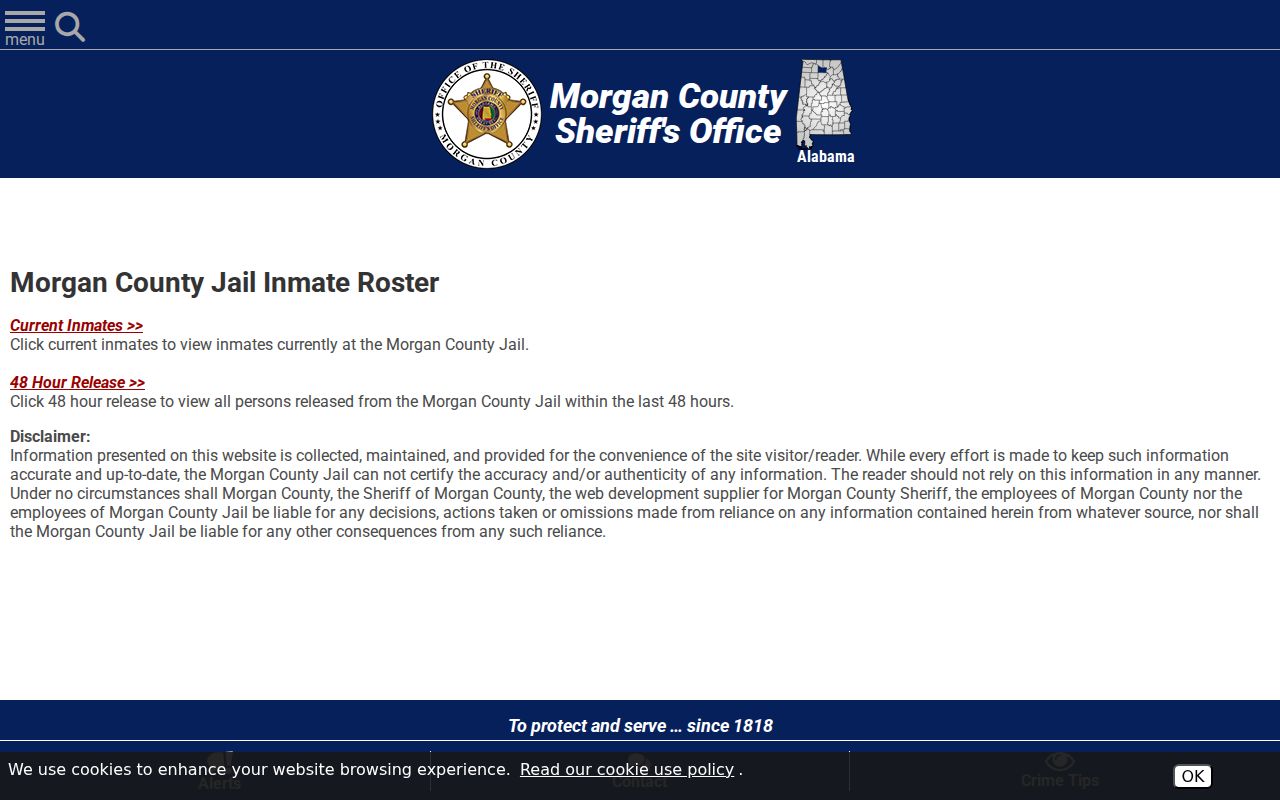
The current inmate roster then displays the booking cards used to trace immediate allegations.
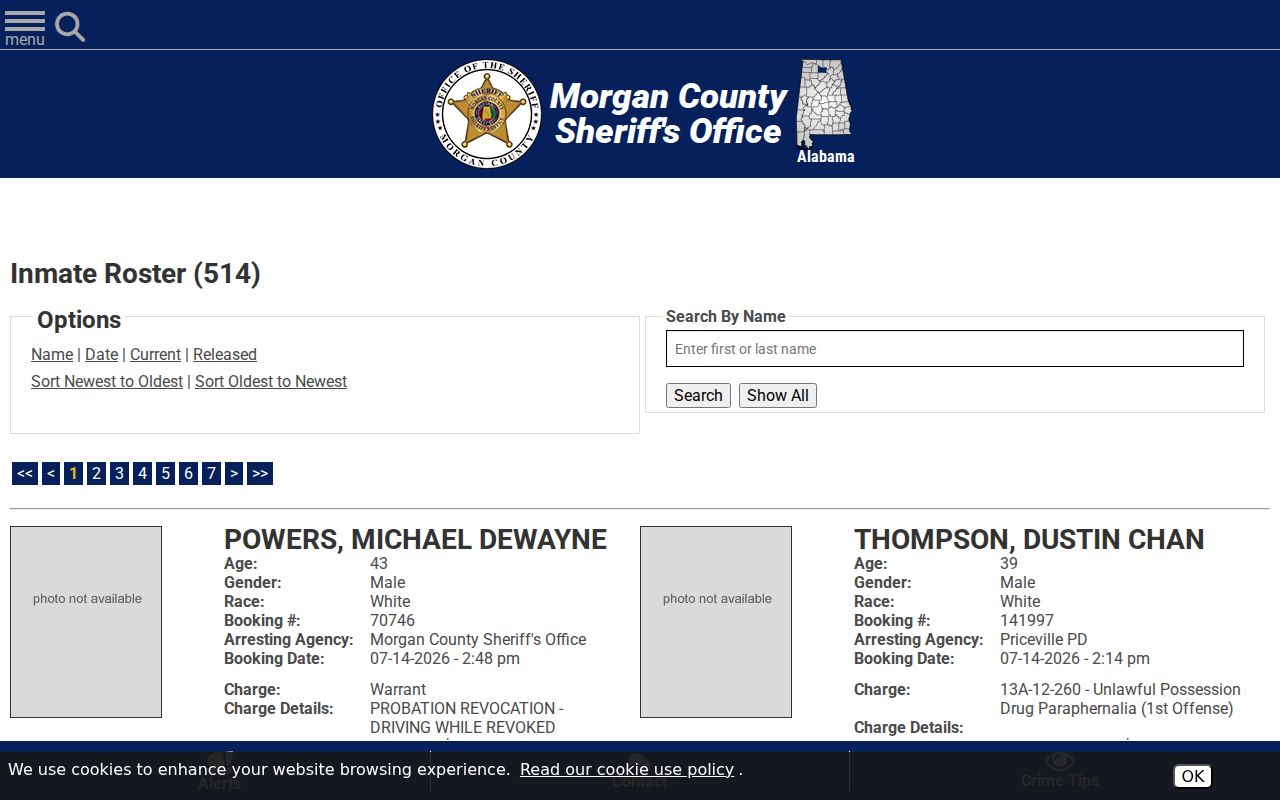
Neither view replaces the court docket when the goal is the final charge result.
Morgan County Charging Documents
A charging document turns an allegation into a court charge. Morgan County research supports complaints and grand-jury indictments in the local case flow. “Information” is included below as a general charging-document term, but the local sources do not establish it as Morgan County's standard felony path. The key local route is District Court after many street arrests, followed by Circuit Court after indictment when a felony proceeds.
| Complaint | Information | Indictment | |
|---|---|---|---|
| Source | Sworn accusation used to begin or support a case | Formal prosecutor-filed accusation where authorized | Formal accusation returned by a grand jury |
| Morgan County role | May support District Court proceedings | Not detailed in local official research | Moves a felony prosecution to Circuit Court |
| Reader check | Compare with the current docket | Read the filed document and authority | Match every count to its later disposition |
Morgan County Charge Status
Charges can change after arrest. A prosecutor may proceed on a different count, and a grand jury may return an indictment that does not mirror the booking card. Later court action may amend, reduce, dismiss, or resolve a charge. Read the latest docket and signed order. Short roster phrases are not a complete status history.
| Status | What It Means |
|---|---|
| Pending | The court has not entered a final result on that count. |
| Amended or reduced | The filed accusation changed; follow the replacement count. |
| Dismissed | The charge ended without a conviction on that count. |
| No-billed | The grand jury did not return an indictment on the proposed felony charge. |
| Nolle prosequi | The prosecution chose not to continue that charge at that time. |
Morgan County Charges Versus Convictions
An arrest and a charge are not convictions. A charge is an accusation. A conviction follows a guilty plea or verdict. One arrest may have several allegations, and each can end differently. Check the disposition and sentence for each count before describing the result.
| Charge | Conviction | |
|---|---|---|
| Stage | Accusation | Verdict or plea |
| Meaning | Claim the government seeks to prove | Guilty plea or verdict |
| Where first seen | Booking card or charging document | Disposition and sentencing record |
| May change? | Yes, through amendment, dismissal, or no-bill | Subject to later court or appellate action |
Sealed and Expunged Morgan Records
Sealing restricts inspection under a law, rule, or order. Expungement follows Alabama's statutory process for qualifying arrest and court records. Eligibility depends on the exact charge, agency, case, and disposition. Some dismissed, no-billed, acquitted, and qualifying diversion outcomes are treated differently from convictions. Juvenile information remains confidential under separate law.
- Sealed record
- A record withheld from routine inspection under a privacy law, court rule, or court order. Access depends on the case and the requester's legal authority.
- Expunged record
- A record restricted through an Alabama expungement order. Review requires the charge, agency, case number, and final disposition.
Read Morgan County Roster Charges
A roster charge may give an Alabama code, a plain-language label, or simply “Warrant.” The accompanying details can be abbreviated. Examples inspected in the official roster included traffic and failure-to-appear text, while bond entries showed municipal, secure, no-bond, and cash-only types. The arresting agency may be the Sheriff's Office, Decatur Police, or another agency. Booking number and date identify the custody event, not the final court case.
The Morgan County Jail corrections page identifies the facility that holds county inmates and its programs.
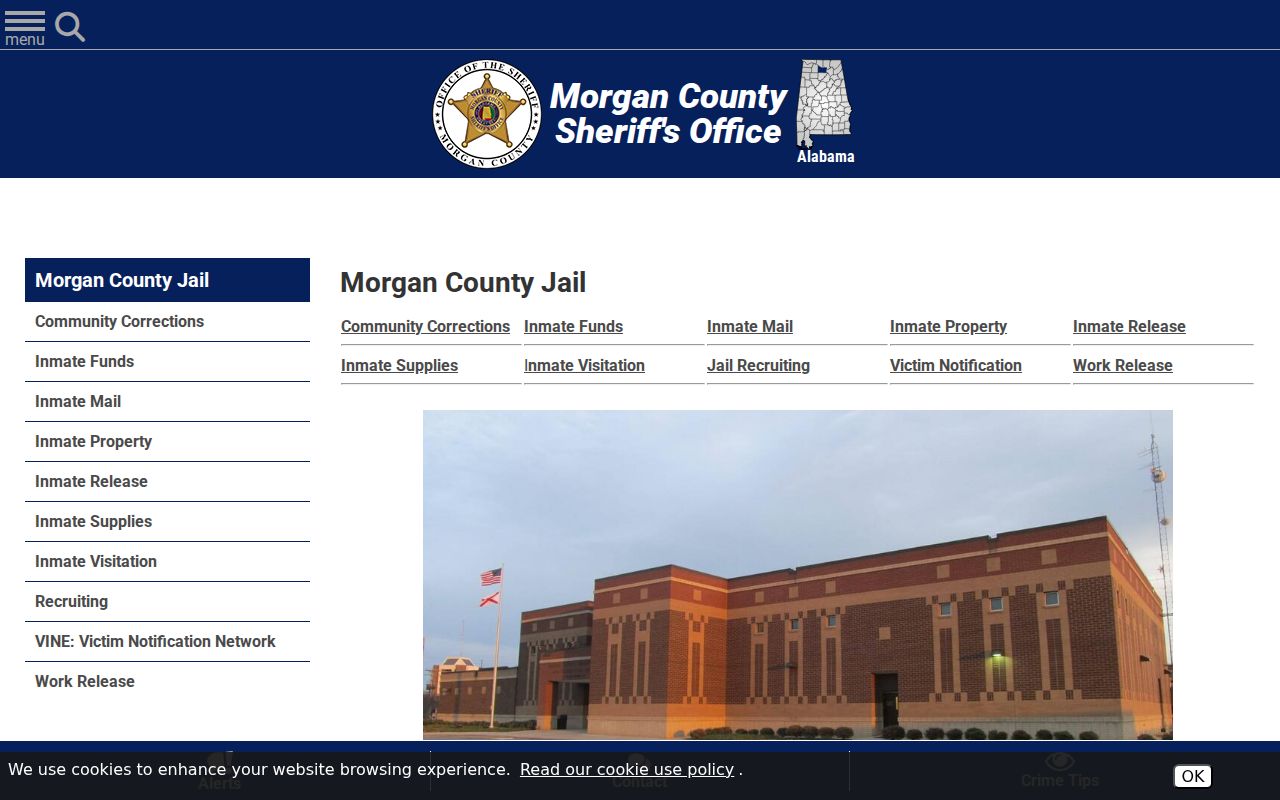
Custody at the jail does not establish the final severity or outcome of a court charge.
Morgan County Arrest Access Channels
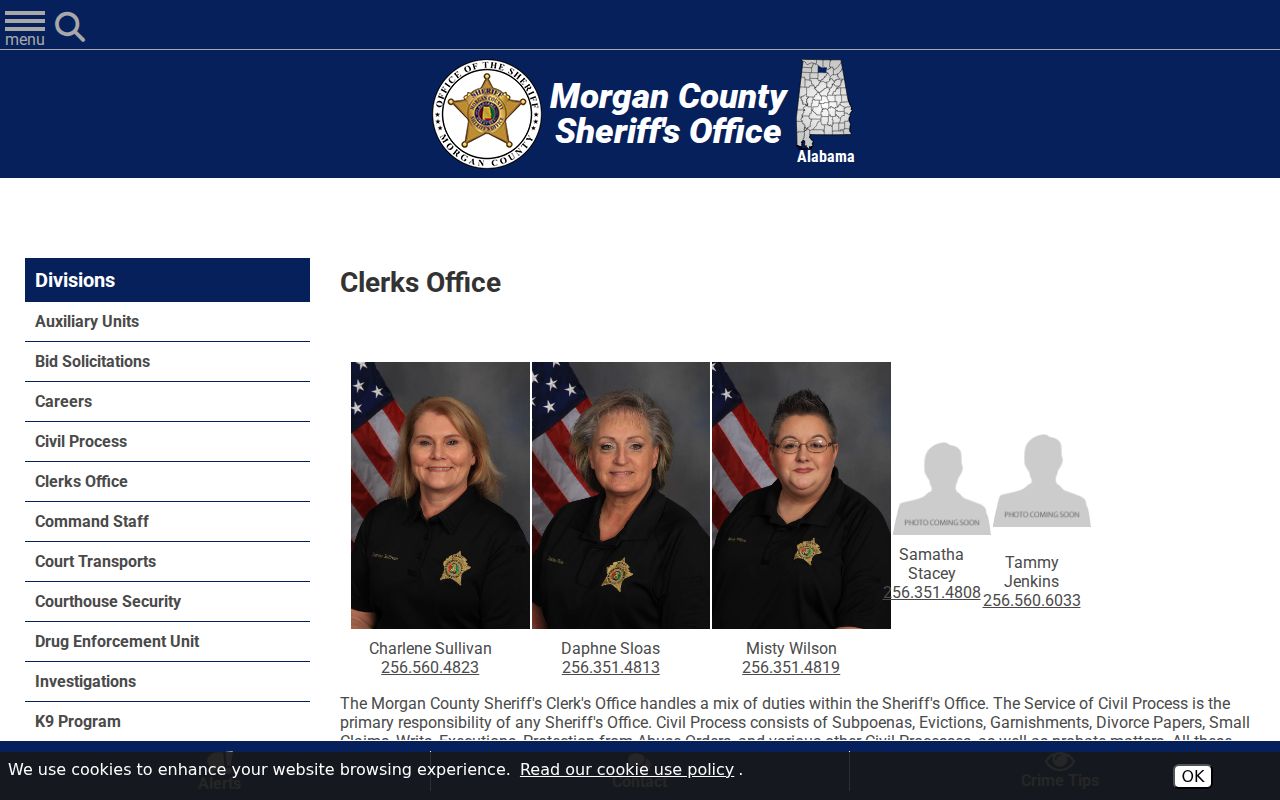
The official sheriff app advertises arrest and warrant details, alerts, tips, deputy commendations, and sex-offender checks. Its official landing page links users toward the app stores, though exact store URLs were not captured. The Sheriff's Clerk's Office also handles administrative work and directs public-record requests to the Morgan County Commission. Unserved warrants remain non-public.
The Sheriff's administrative office page supplies that records-request referral.
The official Morgan County sheriff app page documents the mobile arrest and warrant feature.
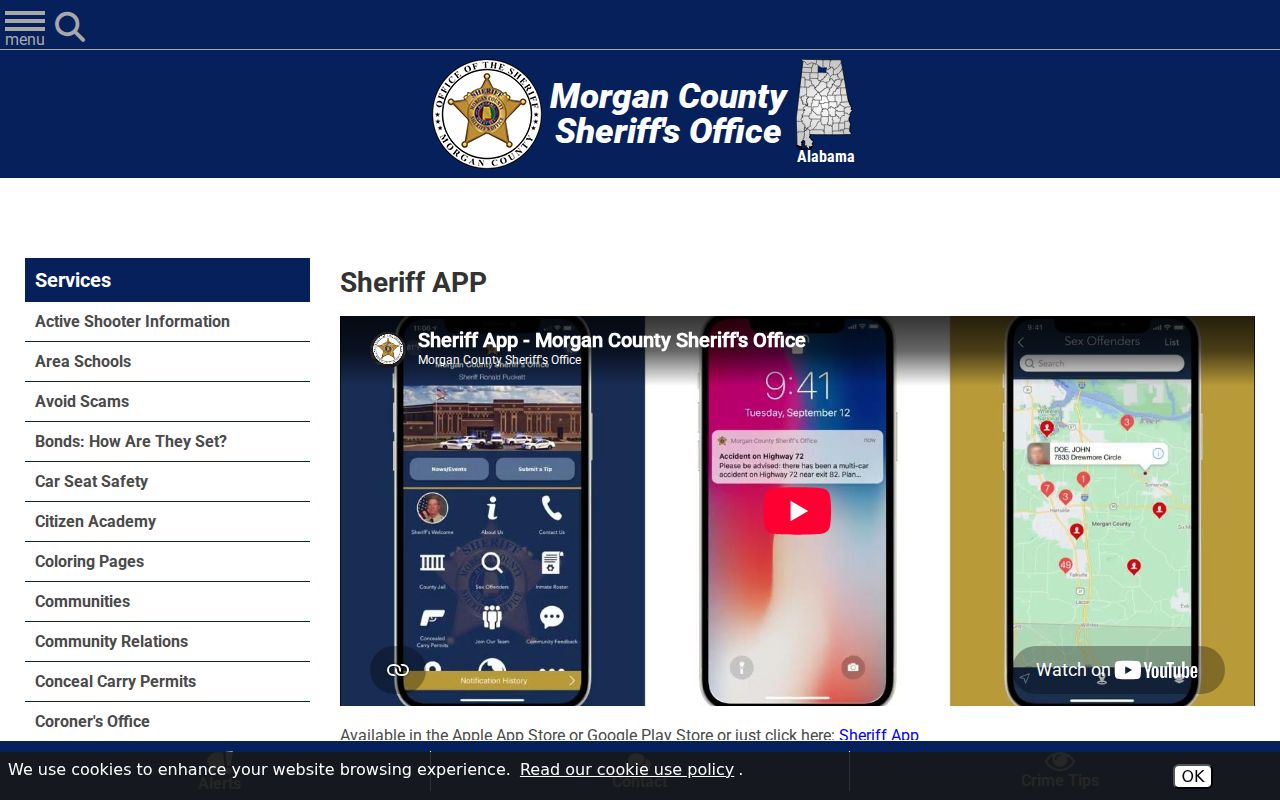
These channels supplement the roster and clerk record rather than replace either one.
Morgan County Bonds and Notifications
Bond fields describe release terms, not guilt. After a street arrest, a defendant may ask District Court for a preliminary hearing within 30 days and may seek bond reduction. A judge can ask Community Corrections for a pretrial assessment. Release may use own recognizance, cash, property, or a surety. Judges may depart from schedules, and some serious cases can begin with no bond.
VINE provides a separate custody-notification channel. Morgan County Jail participates in the free and anonymous service. Users can register for email, text, or phone notice of release, transfer, or escape, or call 1-877-846-3425.
The official Morgan County VINE page explains those notifications.
VINE tracks custody change; it does not report the court's final disposition.
Important: Verify every booking allegation against the court disposition before treating it as a case outcome.
Restricted Morgan County Charge Records
Juvenile case information is confidential under Alabama Code Section 12-15-133. Expunged and sealed charges are not routine public results. PFA victim addresses and phone data can be protected. Mental-health, adoption, sensitive-identifier, and active-investigation material may also be restricted. An absent web result does not prove no arrest or case exists.
Scott Anderson's Morgan County District Attorney's Office prosecutes felony and many state criminal matters in the 8th Judicial Circuit. Defendants who cannot afford counsel should ask the judge or clerk at the first appearance about appointed counsel because no verified county public-defender office page was found. The clerk can explain records and procedure, but not give legal advice.
The arresting agency and prosecutor answer different questions. An agency creates arrest material and delivers the person for booking. The district attorney reviews evidence and prosecutes applicable state charges. The grand jury determines whether evidence supports an indictment, while the court records pleas, hearings, disposition, and sentence. A booking-number or agency error belongs first with the sheriff; a court disposition issue belongs with the Circuit Clerk or court.
Municipal cases add another split. A Decatur, Hartselle, Priceville, Falkville, Somerville, or other city arrest may lead to a city ordinance, traffic, or bench-warrant matter held by the municipal court. County Warrant Magistrate misdemeanor jurisdiction applies outside municipal city limits. When Alacourt or the county roster does not answer the question, identify the issuing police department and contact its municipal court before concluding that no charge record exists.
Alabama public-record law generally favors access to public writings, subject to court rules and statutory limits. Sections 36-12-40, 36-12-41, and 36-12-44 address inspection, copies, clarification, and timing. The Circuit Clerk records page supplies an official request form and policy for court files. The Sheriff's administrative page directs sheriff requests to the Morgan County Commission. Each channel can disclose only records that are public and held by that office.
Note: Keep the booking number and court case number separate because they identify different records created at different stages.
A recent release from the Morgan County Jail does not end the court case. Release may follow bond, an own-recognizance order, transfer, or another custody decision while charges remain pending. VINE can notify a victim about custody change, but only the District or Circuit Court docket can show the next hearing and later disposition. Conversely, a court charge can remain in the file after the person is no longer on the current roster. Search both systems when the question spans arrest, release, and prosecution.